Establishment of the Center
The Scientific and Technical Research Center for the Development of the Arabic Language is a public institution of a scientific and technological character, possessing a joint sectoral nature. It is governed by the provisions of Executive Decree No. 256-99 dated November 16, 1999. The Center enjoys legal personality and financial autonomy and operates under the supervision of the Ministry of Higher Education and Scientific Research.
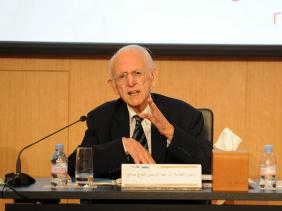
الأستاذ الدكتور عبد الرحمان الحاج صالح
مؤسس المركز
The Scientific and Technical Research Center for the Development of the Arabic Language was established on December 14, 1991, by Executive Decree No. 477-91. It succeeded the Institute of Linguistics and Phonetics and the Research Unit in Language Sciences and Linguistic Communication. It became a public institution of a scientific and technological character on December 31, 2003.
The Scientific and Technical Research Center for the Development of the Arabic Language comprises five departments, with each department encompassing research teams. These departments are:
- Department of Computational Linguistics
- Department of Arabic Linguistics, Lexicography, Arabic Terminology, and Translation Studies
- Department of Teaching Arabic and Comparative Language Education
- Department of Spoken Communication and Speech Pathology
Here, we find that all specialties share a single research subject: Human Language, building upon the latest developments in research across various fields, particularly those related to the tools of modern scientific study applied to languages and specifically to the Arabic language. From this perspective, the Center is considered unique in Algeria, the rest of the Arab world, and even at the international level in its focus on the Arabic language.
The Center’s fundamental tasks
The Center’s fundamental tasks lie in conducting theoretical and applied research on the development of the Arabic language and linguistics, in cooperation with concerned bodies and institutions. This includes orienting, setting, and approving terminology, and implementing research projects in areas related to language behavior and its techniques as applied to Arabic and other widely spoken languages, with the aim of developing the Arabic language at the educational and technological levels.
Research Fields
In this context, the Center also conducts research in:
Arabic Linguistics
This is based on the theoretical framework known as the modern Khalilian theory, with attempts to deepen, develop it, and conduct comparisons with other linguistic theories.
Language Pedagogy and Teaching Arabic at All Educational Levels
By conducting critical scientific studies on the teaching of Arabic and foreign languages in Algeria,and organizing comparative experimental pedagogical workshops and defining methods of language teaching.
Arabic Lexicography and Terminology
Aiming to contribute to the standardization of scientific and technical Arabic terminology at the Arab world level.
The Art and Science of Translation
By conducting scientific studies on translation methods and defining translation techniques that meet the needs of scientific book translators.
Natural Language Processing or Computational Linguistics
By contributing to ongoing research to formulate linguistic theories,especially the modern Khalilian theory, into computational models. As well as conducting critical studies of scientific theories specific to this field and undertaking the development of software and other computational tools to be utilized in language teaching, statistics, speech disorders, databases, etc.
The Field of Automated Databases
By overseeing the implementation of the international project called”The Arabic Corpus” and contributing to this achievement on a permanent basis. This is done in close cooperation with ongoing research in the computational processing of Arabic and, in particular, in cooperation with the International High Authority of the Arabic Corpus project.
Phonetics and the Computational Processing of Spoken Speech
By conducting laboratory studies and preparing appropriate computational tools for the analysis of spoken speech,its synthetic generation, and the automatic discovery of its identity elements. This enables the development of devices for automatic speech recognition and synthesis.
Speech Pathology
By conducting clinical studies on various speech disorders,especially aphasia, and developing methodologies for diagnosing speech impairments and defining appropriate methods for their treatment.
The center’s strategy for achieving its scientific objectives
In order for the Center to fulfill the tasks entrusted to it and achieve its objectives, and given the complex nature of this field—namely, human language and speech behavior, specifically the Arabic language and its uses—the Center undertakes the following:
Summoning experts from diverse horizons, united by the goal of researching language, and specifically the Arabic language. The Center is, in fact, the sole scientific institution that brings together multidisciplinary experts to work on joint projects guided by the sacredness of the language: engineers, specialists in language teaching, lexicographers, speech pathologists, audiologists, specialists in aphasia, speech therapists, specialists in clinical linguistics, etc..
Utilizing technologies such as computing, electronics, acoustics, and phonetics, as well as other methodological and technical tools that meet the necessities of modern, multidisciplinary research..
Basing research on scientific theories that form an epistemological link capable of coordinating the approaches adopted by each team to create compatibility and harmony.
This reflects the diversity of specializations within the Center and its reliance on the achievements of technical fields, embodying the orientation toward modernity that the Center adopts while preserving and enriching the authentic Arabic heritage..